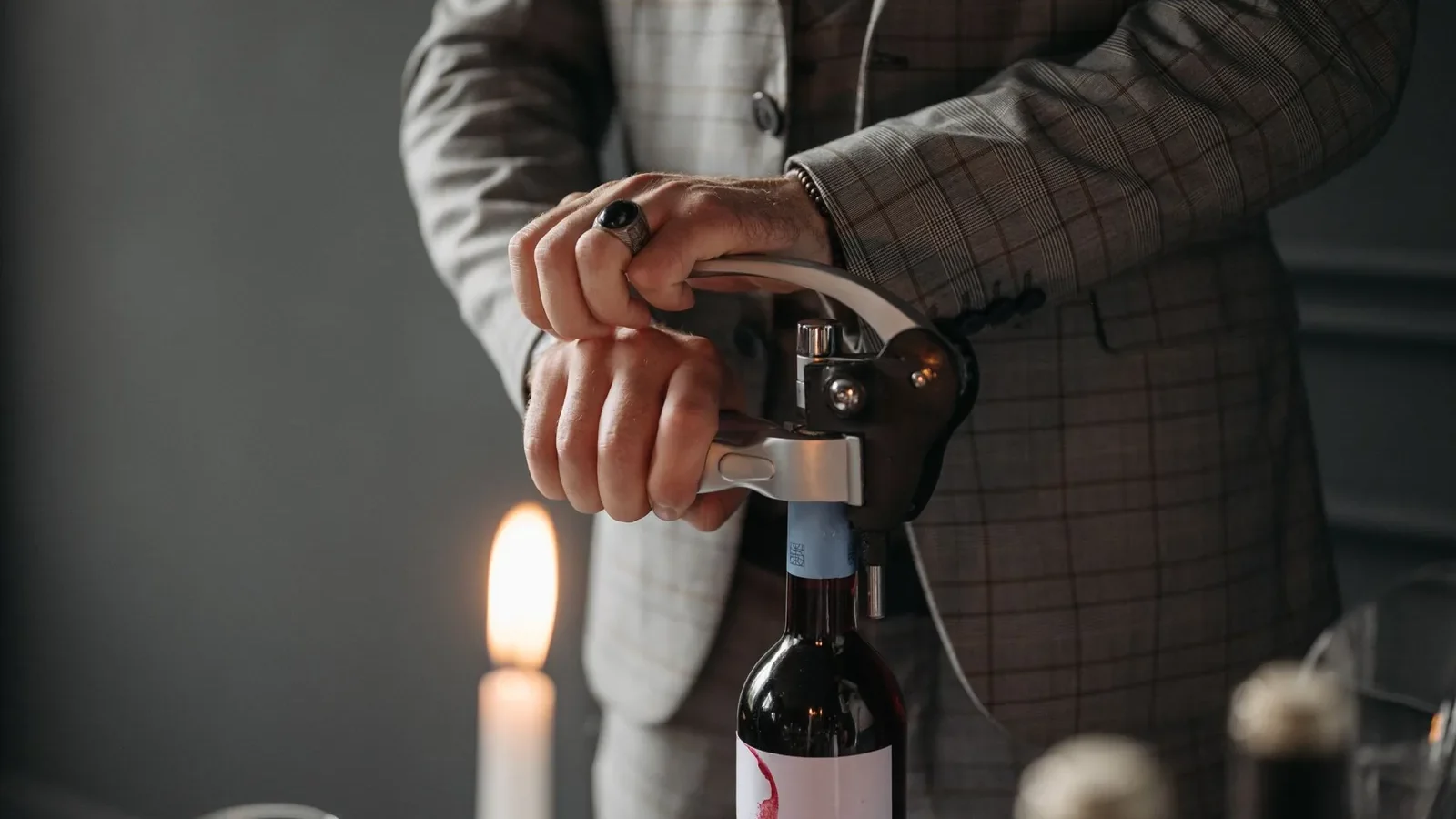
You may have heard about the Coravin, the latest gadget in the wine world that claims to preserve the remaining wine in a bottle after you’ve enjoyed a glass or two. If you’re thinking of buying one, wait, even if you’ve read enthusiastic reviews such as these. Wine critic Robert Parker says, “Coravin is going to revolutionize drinking wine…,” and New York restaurateur Joe Bastianich, who happens to be an investor in the company, says, “This product is nothing short of amazing….” The Coravin has been available for about a year now, enough time for measured evaluations, and users are now telling me that it has positive applications for people in the wine trade but probably won’t help around the house.
The Coravin clamps onto a wine bottle, inserts a small hollow needle through the capsule and the cork, so a user can extract a glass or more of wine without opening the bottle. As the wine pours through the needle into the glass, an attached canister of argon, a completely inert gas, flows into the bottle, replacing the depleted volume of wine in case some air does penetrate. When the needle is extracted, the cork theoretically closes and prevents air from entering, which we all know alters the wine in stages until it oxides entirely within a few days.
Wine sales people pour tastes all day long for retailers, who are choosing wines for their businesses. For these sales people and their employers, the Coravin is a money saver because they know that the wine will probably be pristine during the time that it takes to empty the bottle, maybe as long as 30 days if it’s an unusual wine that they won’t be pouring for all of their customers. They no longer have to dump wine from an unfinished bottle at the end of the day, drink it, or give it away because the wine will not be fresh enough to pour for customers the following day. In fact sales people, armed with Coravins, are leaving fewer opened bottles of wine in my office after tastings.

Restaurateurs are enthusiastic because they can now offer a glass or even less of almost any wine at any price instead of pouring the few bottles that they are certain to sell before the wine looses its freshness and begins to oxidize by the end of the day. Restaurateurs can now pour their very expensive wines by the glass instead of waiting for the customer, who is willing to pay for the entire bottle. Customers are pleased because they can taste highly touted wines without committing to the price of an entire bottle. Some restaurants are pouring and charging by the milliliter, placing the glass on a compact scale at the table so that customers can choose to have tastes rather than a full glass.
But what about home use? The Coravin costs about $300 and a canister of argon about $10. Each canister will replace about 30 glasses, according to Emiliano Camilli from Vinity Wine Company, who was giving me a demonstration. Each amount of argon that replaces a glass costs $0.33. There are five glasses in a bottle, so you’re replacing four glasses with argon, but not the fifth or last glass, thus adding $1.32 to the cost of a $10 bottle of wine. Not so bad.
But what people in the trade are saying is that the Coravin is as good as the cork. Expensive wines will have fine corks that will usually close tightly after the needle is extracted. But inexpensive bottles will be topped with inexpensive corks that will not close tightly enough. The added security that the argon provides would seem to be imperfect.
So that leaves the Coravin investment for the best wines that we have stored in our homes. But I ask you. When was the last time that you drank one of your best bottles by yourself? Most of us share our best bottles with our loved ones and best friends, at least those friends, who will appreciate a fine wine. I think I can speak for most wine lovers when I say that I have no trouble drinking a half bottle of wine with a meal, although I might choose not to, and would have no trouble whatsoever drinking a fine half bottle in the good company of just one other person. Do I need a Coravin? No. And beside, think about how many bottles of fine wine you could buy for $300.
What Actually Happens to an Opened Bottle
Oxygen does two things to wine, and they run on different clocks. Over the first hour or two it can soften a tight young red and open its aromatics, which is the whole point of decanting. Over the following days it keeps going, converting ethanol toward acetaldehyde and eventually toward acetic acid, and the fruit flattens out along the way.
Temperature governs how fast that second process runs. A half-full bottle left on a warm counter deteriorates noticeably quicker than the same bottle in a refrigerator, because the reactions speed up with heat. This is why the cheapest preservation trick of all is simply putting the cork back and using the cold.
The Preservation Methods, Side by Side
Every approach on the market attacks the same problem from a slightly different angle: reduce the oxygen, reduce the contact, or slow the reaction down. None of them stops the process entirely.
| Method | How it works | Main limitation |
|---|---|---|
| Recork and refrigerate | Cold slows the oxidation reactions | Headspace air remains in the bottle |
| Vacuum stopper | Pumps out part of the headspace air | Seal leaks slowly; volatile aromas are drawn off too |
| Decant into a smaller bottle | Fills the container so little air is left | Requires a second clean bottle on hand |
| Inert gas spray | Blankets the surface with heavier-than-air gas | Blanket is disturbed each time the bottle moves |
| Needle-and-argon device | Draws wine through the cork under gas pressure | Depends on the cork resealing behind the needle |
Argon is used for this because it is chemically inert and denser than air, so it settles over the wine instead of mixing into it. The NIST reference data for argon records the physical properties that make it suitable, and the same reasoning explains why nitrogen and carbon dioxide blends appear in commercial systems.
Matching the Method to the Bottle
The right answer depends less on the gadget than on how the bottle will be used. A restaurant pouring by the glass has a different problem from a household finishing a bottle over two evenings, and a device built for one solves nothing for the other.
Fortified and high-acid wines survive longer once opened than delicate low-acid ones, and sparkling wine loses its pressure whatever anyone does to it. That variability is worth keeping in mind before assuming a single tool covers the whole cellar. The wine skills and knowledge section covers the storage and service basics that make any preservation method work better.
FAQ: Keeping Wine After the First Glass
Should an opened red be refrigerated?
Yes, despite the instinct against it. Cold slows oxidation regardless of color, and the bottle can be brought back toward room temperature over half an hour before the next pour.
Does standing the bottle upright help?
It does, modestly, because an upright bottle exposes a smaller surface of wine to the air trapped above it. The neck presents far less area than the shoulder does.
Is leftover wine still useful once it fades?
Often, in the kitchen. A wine past its best for the glass can still deglaze a pan or build a braise, which is a reasonable second life for a bottle described in our food and wine pairing guide or opened for one of the occasions in the wine for celebrations collection.