We have fake diamonds, hardwood floors, fur, meat, among many other fakes. Now we can add fake wine to the roll. But the fake wine under discussion is not about counterfeiting labels and selling plonk to collectors. It is literally about mixing together raw ingredients, none of them grapes, that mimic the taste and effect of wine. The process takes about 15 minutes., according to molecular biologist Mardonn Chua, who began his experiments over a weekend.
Chua grabbed easily available tartaric acid, malic acid, tannin powder, vegetable glycerin, ethanol, and sucros from a local brew store and Safeway and added the aroma compounds ethyl hexanoate (pineapple), butanoate (grape), limonene (citrus), and acetoin (butter) that he got from his lab. According to his online report, he mixed and matched until he got something that tasted like Kendall- Jackson Chardonnay. No surprise there, but he has much higher aspirations.
Chua is now a partner in Ava Winery, located in San Francisco, the very heart of creative destruction. But my take is that he is not likely to destroy the wine market.
Chua has continued his experiments with the aid of gas chromatography-mass spectrometry to identify precise amounts of amino acids, sugars, flavor and aroma compounds in specific wines. He claims to have successfully replicated a sparkling Moscato d’Asti and a 1992 Dom Perignon Champagne and is offering his synthetic Dom Perignon for $50 a bottle, 150 percent less than the authentic one.

Since I have not tasted Chua’s faux wine, all bets are off. The project may well be an ethanol-induced fantasy. But what if these synthetic wines were pleasant enough for a fraction of the price of real wine?
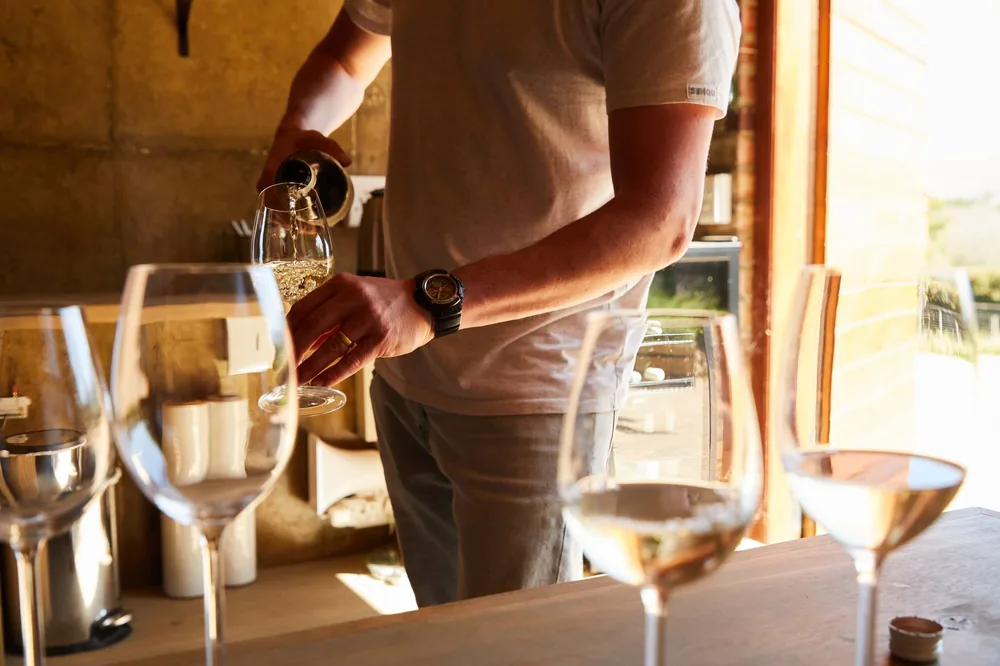
Ultimately, whether Mardonn Chua is onto something important, depends on the taste of his product. While I can imagine that he could synthesize a mass-produced wine, which from year to year and batch to batch is configured to be consistent in flavor, aroma, color, and texture, he could never reproduce the subtleties and quixotic variation of fine wine from bottle to bottle, glass to glass, and sip to sip, that makes authentic wine so captivating.
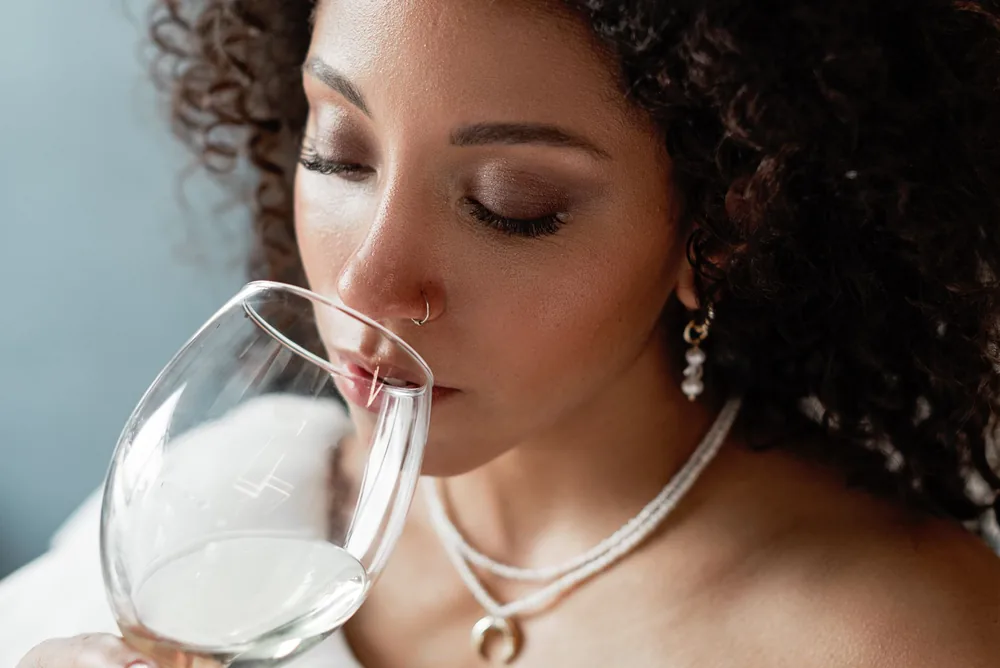
And Chua could never reproduce the connection that wine has to the earth, to the farmers tending the vine, to the winemaker, who’s vision for that wine is the result of imagination.
But then, Mardonn Chua is not trying to do any of that. So let’s see what he does manage to do.
What a Synthetic Wine Has to Reproduce
Wine contains hundreds of volatile compounds, most of them present in trace amounts, and perception depends on the ratios between them rather than on any single molecule. Esters contribute fruit, higher alcohols contribute weight and solvent notes, terpenes contribute floral character, and volatile thiols contribute the tropical and grassy edges. Assembling a convincing imitation means matching a moving target where compounds interact and suppress one another.
A single component gives the flavor of that component. Ethyl hexanoate, one of the compounds named in the experiment above, is catalogued with its physical properties and known occurrences in the National Institutes of Health PubChem entry for ethyl hexanoate, and it smells recognizably of fruit on its own. Wine is what happens when several hundred such compounds arrive together in a specific ratio.
Structure Is Harder Than Aroma
Aroma can be approximated by addition; mouthfeel cannot. Glycerol, alcohol, acid, tannin, and dissolved carbon dioxide combine to produce the sensation of body, and each is perceived through a different mechanism. Tannin in particular binds with proteins in saliva, and the texture that produces depends on the size and structure of the tannin molecules rather than on their total quantity.
Fermentation also creates a matrix in which those compounds sit. Yeast produces and consumes intermediates over days, and the finished wine keeps changing slowly for years afterward. A blended solution starts stable and stays that way.
| Trait | Fermented wine | Formulated blend |
|---|---|---|
| Origin of aroma | Grapes, yeast, and aging | Added compounds |
| Bottle-to-bottle variation | Inherent | Engineered out |
| Behavior over years | Develops, then declines | Static or degrades |
| Cost driver | Land, farming, and time | Ingredients and analysis |
| Legal class | Wine, under federal standards | Not wine, however it tastes |
Where Analysis Runs Out
Gas chromatography paired with mass spectrometry will identify and quantify what is in a sample with great precision. Human perception does not work in the same units, since detection thresholds vary by compound over several orders of magnitude and compounds mask or amplify one another. A molecule present at a level the instrument barely registers can dominate the glass.
That gap is why sensory panels remain the standard for evaluating wine even in well-equipped laboratories. Chemistry describes the sample; people describe the experience. Reconstructing the second from the first is the unsolved part of the problem.
Variation Is Part of the Product
Consistency is a virtue in manufacturing and only a partial virtue in wine. A vintage is a record of a particular growing season, and the differences between one year and the next are the reason collectors keep notes and growers argue about picking dates. Removing that variation removes much of what the category is for.
Even within one vintage, a wine changes in the glass over an hour and in the bottle over years. Two bottles from the same case, stored together, can show small differences attributable to their closures alone. A drinker who finds that frustrating is better served by a consistent industrial product, and there is no shame in that preference.
The counterargument in the newsletter above is essentially about meaning rather than chemistry. A wine carries information about a place, a season, and a set of decisions, and a formulated drink carries information about a recipe. Both can taste good; only one can be read.
The Legal and Commercial Boundary
Federal standards define wine as the product of fermented grapes or other fruit, so a beverage assembled from purchased compounds cannot be sold as wine in the United States regardless of how it tastes. It would be a separate category with its own labeling. That distinction matters commercially, because the value of a wine label rests on where and how the fruit was grown.
The plausible market for such products was always the low end, where consistency is the main promise and provenance is not part of the appeal. Nothing about it threatens a wine whose entire proposition is a specific site in a specific year. The regional character behind that proposition is mapped in the California wine regions guide.
Judging What Is in the Glass
Stories like this one reward the same skill as counterfeit bottles do: tasting attentively enough to describe a wine on its own terms. Someone who can characterize acidity, tannin, and length is not easily fooled by a label or by a novelty. Building that vocabulary is the point of the wine skills and knowledge guide.
The broader argument in the newsletter above still holds. A drink can be pleasant without being wine, and calling it something else costs nobody anything. More of these debates are collected in the hot topics archive.
Synthetic Wine FAQ
Are flavor compounds added to ordinary commercial wine?
Added flavorings are not permitted in standard grape wine in the United States, though various processing aids and adjustments are. Products that do contain added flavoring must be labeled differently. The rules on additions are far tighter than most drinkers assume.
Could a blended imitation ever age?
Aging depends on slow reactions among tannins, acids, and phenolic compounds that a simple solution does not contain in the right forms. Without them, time only degrades what is there. Development is the hardest property to fake.
Is dealcoholized wine the same idea?
No. Dealcoholized wine begins as fermented grape wine and has its ethanol removed afterward, so its aromas are genuinely of grape origin. A formulated drink never had grapes in it at all.