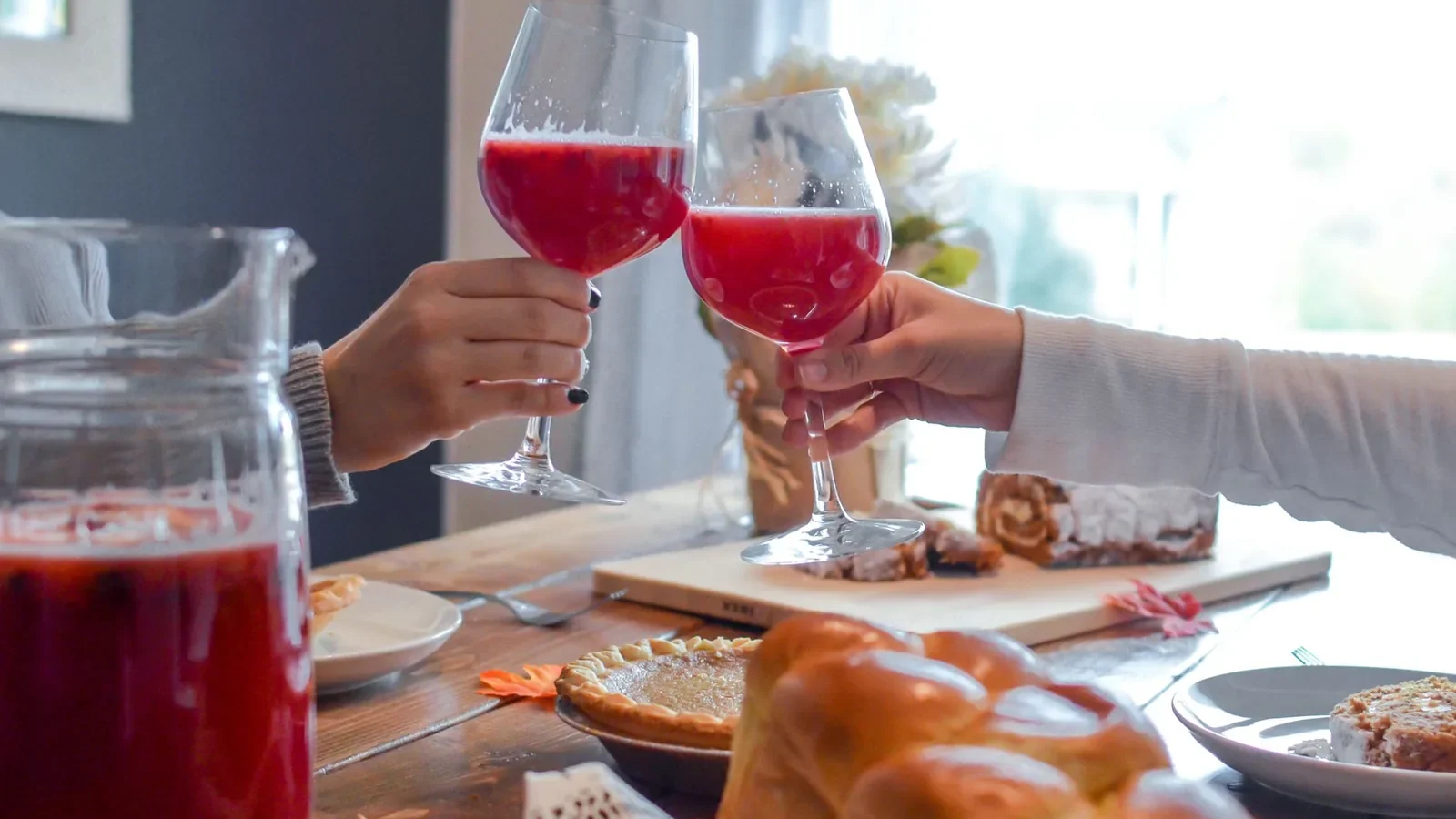
Countless words have poured onto paper, advising people which wines to serve for the Thanksgiving celebration. I may as well add a few more. First off, I’m biased towards whites for this meal, an off-dry Gewurztraminer or Riesling or a sparkling wine, so that I don’t have to worry about poisoning my glass with cranberry sauce or a yam that will turn the wine sour. But there are legions of wine drinkers, who are biased toward red, no matter what the menu is. The prevailing wisdom for them is that California Pinot Noir or a light Zinfandel, or a fruity Euro red like Beaujolais or Barbera would complement the meal. Because the controversy continues to rage, I though we might consult the ancients, who created this holiday and its menu in the beginning. What did the Puritans drink? What did George Washington prefer? History weighs in with some surprising suggestions.

The historical record tells us that 90 Native Americans from the Wampanoag tribe and 41 Puritans met for three days in the fall of 1621 to celebrate a successful harvest after a previous winter and spring of misery for the settlers. Sixty-one of the original 102 Puritans, who disembarked from the Mayflower, had died from disease and deprivation. We know from William Bradford and Edward Winslow, who were both in attendance at the feast, that they ate cod and bass, waterfowl and wild turkey, venison, and corn.

What they drank is less clear. The English, including the Puritans, considered water dangerous even for bathing. The drink of choice was beer. Both the Anglican Church and the Puritans considered alcohol a gift from God. Drunkenness, on the other hand, was the work of the Devil. But whether these settlers packed enough beer in the Mayflower to sustain their community for an entire year is questionable. With the help of the native Wampanoags, the settlers grew both corn and barley, but the historical record does not indicate that they made beer from their small barley crop. We know that they praised the water on the site as being as good as beer or wine. Yet regardless of what they actually drank, the Puritans would have certainly wanted it to be beer.
Thanksgiving celebrations occurred spontaneously and sporadically from community to community, from state to state to commemorate particular events. For the first time in 1789, President George Washington designated Thursday, the 26th day of November as a national day of thanksgiving for the entire nation after the defeat of the British at Saratoga. But the occasion was still a one time event rather than a recurring yearly holiday.
We can guess what Washington probably drank to celebrate the occasion because we know what he served with meals at his 8000-acre Mount Vernon estate. His beverage staples were beer, Madeira wine, and Port. The food that he would have eaten with these beverages were fish, which he consumed regularly, and pork, mutton, goose, duck, turkey, roast beef, hominy, tripe, and ham, which he often served to his many guests. From his extensive gardens, he harvested potatoes, squash, carrots, cabbage, lettuce and other seasonal vegetables and herbs. Wine accompanied dessert at Mount Vernon and included ice cream, his favorite, and pies, tarts, fruits, nuts, and cheeses.
So there you go. While history dictates the Thanksgiving Day menu, consisting of foods that are native to the United States, it leaves us free to open any wine that we desire. But beer would be the most faithful to our past.
What colonial households actually drank
Beer in the seventeenth century was not the drink it is now. Household brewing produced a thin, mildly alcoholic beverage consumed by adults and children alike, made in batches every week or two because it did not keep. Strong beer existed, but it was the exception rather than the daily ration.
Cider took over quickly in New England because apple trees thrived where barley struggled. Orchards planted in the first decades of settlement were producing heavily within a generation, and pressed juice fermented on its own without any equipment a farm did not already have. By the eighteenth century, cider was the common table drink of rural New England, and beer had become the drink of towns with commercial breweries.
Wine was a different matter. Nearly all of it arrived by ship, which made it a luxury tied to the Atlantic trade, and the fortified wines of Madeira and the Iberian islands traveled best because their higher alcohol survived warm holds. That is the practical reason Madeira and Port turn up so often in the cellar records of wealthy households.
How the holiday itself became fixed
Days of thanksgiving were proclaimed occasionally for particular events, by colonies and later by states and by Congress, long before any of them recurred on a schedule. The 1789 proclamation described in the post above was one such single occasion rather than the start of an annual holiday. The National Archives keeps the legislative record behind the Thanksgiving holiday, including the resolutions and proclamations that eventually settled it in November.
Regional practice filled the gap in the meantime. Harvest feasts, militia musters and church days each carried their own customs, and what appeared on the table depended on what a household had preserved by late autumn. The national holiday eventually absorbed those local habits rather than replacing them.
The menu hardened later than the date did. Nineteenth century magazines, cookbooks and the campaign of Sarah Josepha Hale did more to standardize turkey, pies and the rest than any founding document. What we treat as historic is mostly Victorian.
Why the table is genuinely hard on wine
The difficulty is not the turkey, which is mild and takes almost anything. It is everything surrounding the turkey: cranberry sauce with its sharp acidity, sweet potatoes with brown sugar, sage stuffing, and a gravy that carries salt and fat across the whole plate. A single glass has to sit beside four or five competing flavors at once.
Wines with their own acidity survive that crossfire because acid meets acid instead of being flattened by it. A trace of sweetness handles the candied dishes, and moderate alcohol keeps the wine from turning hot next to salt. Heavy tannin and high alcohol are the two traits most likely to clash.
| Trait | Helps | Hurts |
|---|---|---|
| Acidity | Stands up to cranberry and vinegar-dressed sides | Low acid tastes flabby against sweet dishes |
| Sweetness | A touch balances candied yams and glazes | Fully dry wines can read as bitter beside them |
| Tannin | Light tannin stays out of the way | Firm tannin turns harsh with salt and sage |
| Alcohol | Moderate levels keep the wine refreshing | High alcohol amplifies salt and heat |
| Bubbles | Reset the palate between rich bites | Rarely a problem at all |
Holiday wine FAQ
Does one bottle really have to cover the whole meal?
It does not, and the easiest solution is to open two contrasting styles and let guests move between them. A crisp white and a light red on the same table cover far more of the plate than either can alone.
How much wine does a holiday table go through?
A standard bottle pours about five generous glasses, and a long afternoon meal tends to run to roughly half a bottle per adult. Counting on that basis is more reliable than counting on appetite. Sparkling wine disappears faster than still wine because it is poured before the meal as well as during it.
Should the white be served straight from the refrigerator?
Usually not. Very cold wine goes mute, and ten minutes on the counter brings back the aromatics that make an off-dry white worth serving. Our notes on matching food and wine and on wine for celebrations go further into serving choices for large meals.