As Thanksgiving approaches, we’re inundated with advice about which wines to serve at the feast. Some voices advocate for certain wines, others for different ones. And in addition to contradictory preferences, the advice is subject to trends. A handful of years ago, Zinfandel both white and red held sway. That advice has been off the table for awhile as red Zinfandel has transformed into a super red, which everybody agrees won’t work with this meal. If you’ve decided to opt out of the fray and rely on tradition, serving spring water and beer like the Puritans did, you’d have good reason. And there’s always apple cider, which can be a wonderful beverage these days.

But assuming that you are like me, careless with controversy and unable to eat a meal, any meal, without wine, you’ll probably move ahead with your own choices. So please don’t consider what you’re about to read as advice. It’s simply one woman’s wine practice for a meal that she dearly loves.
Despite the importance of the holiday, I consider it a relatively informal gathering and expect family members and friends to wander over to my house a good deal earlier than when the meal will actually begin at the table. And anyway, dinner time depends on my timing, and that can be unreliable. So sparkling Prosecco is the welcoming glass along with a few simple appetizers. Bubbles are synonymous with celebration, and Prosecco is my perfect aperitif for Thanksgiving, not only because it’s deliciously refreshing, but it’s also light at only 11% alcohol unlike champagne, which can be 12.5% to 13.5% or more. Since a lot more wine will be served at the table, exhausting alcohol tolerance before the meal has even begun is unwise.

Finally everyone is sitting around the table and the feast begins, turkey, stuffing, gravy, cranberry sauce, sweet potatoes, string beans or zucchini, and salad last at my table. For me, this combination requires white wine, still or sparkling, and rose`. The old adage “white wine with white meat and red wine with red” applies here without equivocation. But which white wines? Don’t tell, but in my case, the answer becomes whatever is in the warehouse at the time. But if I were to decide more thoughtfully, I would say Gewurztraminer or Riesling with the slightest bit of residual sugar. These wines refresh with acid and complement yams and sweet potatoes, and anything sweet in the stuffing. They’ll even hold up to cranberry sauce if you happen to be talking to the person next to you and take a sip of wine without thinking about your last mouthful. Aromatic dry whites are also a good choice, like Pinot Grigio, Pinot Bianco, and Sylvaner. Even Chardonnay and Rousanne could be good, especially those fermented in stainless steel tanks instead of oak barrels so that they have retained their acidity and pure fruit flavors. But if you think a table isn’t a table without a red wine on it, it needs to be very light and fruity. Rose’ wouldn’t be red enough for your taste, so for you, I’d choose Beaujolais or even a light Grenache.
Last, but definitely not least, the desserts arrives, and with them, I’ll be serving sparkling Moscato d’Asti, typically around 5% alcohol, remarkably aromatic and light bodied, just what everyone needs to refresh at that point in the meal. I can hardly wait!

Why this particular meal is hard to pair
Most pairing advice assumes a plate with one main flavor and a sauce. The American Thanksgiving table breaks that assumption completely, since it presents sweet, salty, sour, savory and starchy dishes at the same time on the same plate. No single wine will flatter every combination, which is why the arguments the passage above describes recur every year.
The holiday itself was fixed relatively late. Its origins as a harvest observance and its long path to a national date are set out in the encyclopedia entry for Thanksgiving Day, which is a useful reminder that the menu is a tradition assembled over time rather than a fixed inheritance. The wine, being a later addition still, is under no obligation to be traditional at all.
Two properties do most of the work regardless of which bottles are chosen: acidity, which resets the palate between rich mouthfuls, and a touch of sweetness, which keeps sweet side dishes from making a dry wine taste sour. Almost every successful choice for this meal has one or both.
Dishes and the wine styles that handle them
| Dish | What makes it difficult | Style that copes |
|---|---|---|
| Roast turkey | Lean white meat, rich dark meat | Aromatic whites, dry rose, light reds |
| Cranberry sauce | Sharp acidity plus sugar | Wine with matching acidity and a little sweetness |
| Sweet potatoes | Sweetness and spice | Off-dry aromatic whites |
| Stuffing and gravy | Salt, fat and herbs | Sparkling wine or a fresh, unoaked white |
| Dessert course | Sugar overwhelms dry wine | A wine sweeter than the dish |
Sequencing and quantity
The practical problem at a long holiday gathering is duration rather than matching. Guests arrive early, the meal runs late, and the wine that opens the afternoon has to be light enough that nobody is finished before the table is set. That is the reasoning behind an aperitif at a lower alcohol level.
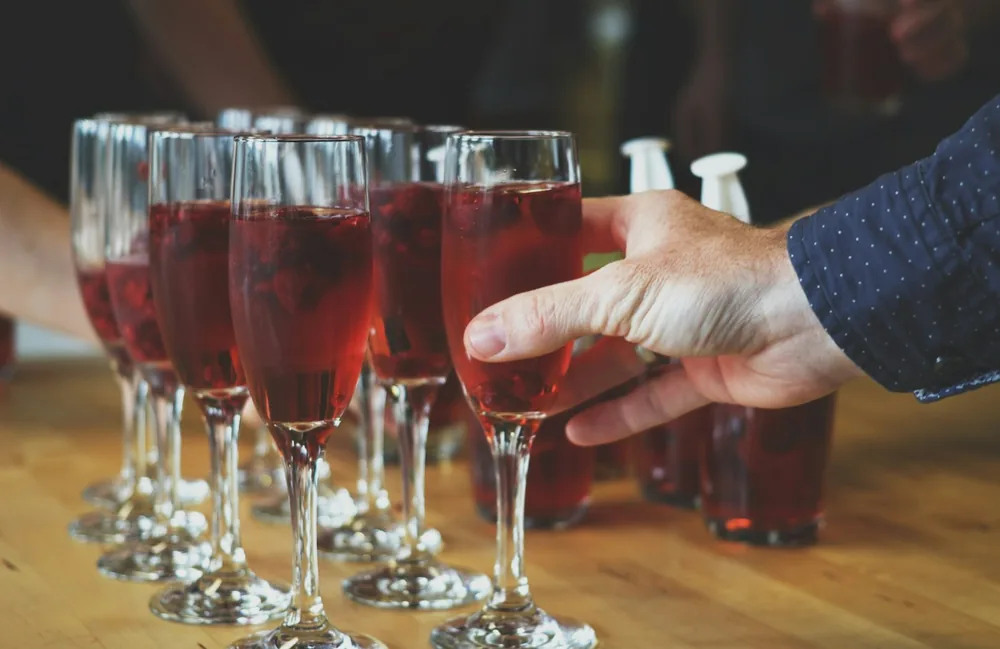
Quantity planning is simple arithmetic. A standard bottle pours about five to six glasses, and a rough planning figure of half a bottle per drinking adult across a long meal covers most gatherings without waste. Sparkling wine goes faster than that in the first hour, so allow more of it than seems necessary.
Sequence of service matters as much as quantity. Lighter wines before heavier ones, drier before sweeter, and younger before older keeps each pour from being flattened by what came before it. The one rule worth breaking is the sequence itself, since guests at a holiday table rarely drink in the arrangement a host imagined.
Glassware can be simplified without loss. A single medium-sized glass with a tapered rim serves every wine on this table adequately, and having one glass per guest rather than three keeps the table clear for food. Anyone who wants a second glass for reds can add one without redesigning the setting.

Temperature does more than the label
Serving temperature changes a wine more than most people expect, and the holiday kitchen works against you in both directions. Whites straight from the refrigerator are usually too cold to smell like anything, while reds sitting near a hot oven quickly become soupy and alcoholic.
- Sparkling wine: thoroughly chilled, and returned to the ice bucket between pours.
- Aromatic and off-dry whites: cold but not frigid, taken out of the refrigerator a few minutes before pouring.
- Rose: the same treatment as a white, slightly less cold if it has some weight.
- Light reds: cool, around cellar temperature, which in a heated house means a short spell in the refrigerator.
- Dessert wines: cold, and poured in small measures.
Our notes on matching food and wine and on wine for celebrations cover the same territory for other holidays, where the same acidity-and-sweetness logic applies.
FAQ: wine for the holiday table
How many bottles should I plan for?
Roughly half a bottle per drinking adult across a long meal, adjusted for how many guests are actually drinking. Extra sparkling wine is more useful than extra red, since it disappears fastest.
Should the wine be sweet?
A trace of residual sugar helps against cranberry sauce and sweet potatoes, but a genuinely sweet wine belongs with dessert rather than with the main course. Off-dry is the useful middle ground.
What about guests who only drink red?
Choose the lightest, freshest red available rather than a powerful one, and serve it cool. Our guide to California grapes and styles covers which varieties are made in that lighter fashion.