
Nearly every American appellation is drawn around something administrative — a county, a watershed, a valley floor with an obvious rim. This one was drawn around a number. Approved in 1981 as the eighth viticultural area in the country, and the first defined by its mountain topography, the boundary described in any honest Santa Cruz Mountains wine region guide is a contour line traced around a range.
The consequence is that a vineyard here is included or excluded by how high it sits, regardless of which of three counties it happens to be in. Santa Clara, Santa Cruz and San Mateo all contribute ground, and none of them contributes all of theirs.

Two contours, two opposite reasons
On the Pacific side, the appellation stops at 400 feet. On the inland side facing San Francisco Bay, it stops at 800 feet. Along the spine the land carries on to 3,000 feet and above, and roughly 480,000 acres sit inside those limits with only about 1,500 of them planted to vines.
The two figures are not a drafting inconsistency. Below 400 feet on the ocean side, the sea is close enough and the fog thick enough that fruit struggles to ripen at all. Below 800 feet on the bay side, the problem reverses: the valley floor is too warm, and the wines lose the tension that makes mountain fruit worth the trouble of growing.
So the same appellation excludes low ground twice, for contradictory reasons. That is the single most useful fact about the place, and it explains why sites a few miles apart can behave like different regions.
What the fog actually does here
Marine fog rolls off the Pacific and pushes up the western canyons overnight, filling them and then draining back through the morning. Vineyards below the fog get filtered light, cool afternoons and a very long hang. Vineyards above it get full sun on their leaves while the cold air sits in the canyon underneath them.
Redwoods make the pattern visible without a thermometer, because they live on summer fog drip and stop where it stops. California’s oldest state park sits in the middle of the range, and the Big Basin Redwoods description from California State Parks notes elevations there running from sea level to over 2,000 feet — the full vertical span the appellation is arguing about.

The crest itself is a different climate again. Castle Rock State Park sits, in the department’s own words, on one of the highest ridges in the range, with black oaks, knobcone pines and high-elevation coast redwoods growing in sandstone. Vines planted at that height are above the fog for most of the season.
| Trait | Pacific slope | Bay slope | Ridge crest |
|---|---|---|---|
| Where the AVA begins | 400 feet | 800 feet | Above both, to 3,000 feet and higher |
| Why the line is there | Below it, ripening is unreliable | Below it, the ground runs too warm | It is the spine joining the two |
| Fog | Fills the canyons and lingers | Rarely climbs this high | Usually sits below the vines |
| Afternoon | Cool, often overcast | Warm, sunny, sheltered | Bright and exposed, wind-scoured |
| Grapes it suits | Pinot Noir, Chardonnay | Cabernet Sauvignon, Merlot | Cabernet Sauvignon, Chardonnay |
Reading a Santa Cruz Mountains wine region guide by aspect
Because the range separates two very different bodies of air, the grape mix here is unusually balanced. Pinot Noir, Chardonnay and Cabernet Sauvignon each account for roughly a quarter of what is planted, which is not a distribution you find in Napa or on the Sonoma coast. Merlot, Zinfandel, Syrah and a scattering of Italian and Iberian varieties fill the remainder.
Soils are thin, stony and largely residual, weathered in place from Franciscan shale and sandstone rather than deposited by a river. Vines on that ground are naturally low-vigor, crop lightly and produce small berries. Ben Lomond Mountain, recognized in 1988, remains the only sub-appellation inside the boundary.
The archive knew the geography from the inside. A 2013 profile described a family farming a fifty-acre vineyard in the Santa Cruz Mountains at Corralitos, on a knoll overlooking Monterey Bay — the August 2013 California winery of the month covers the site and the family’s century in Bay Area winemaking.

Why growers came here in the first place
Vines were planted through these mountains from the 1870s onward, and Prohibition emptied most of them. The revival from the 1960s was driven by people who wanted cold sites for Burgundian grapes and steep, poor ground for Cabernet, at a time when neither was fashionable.
A 2011 club profile records that reasoning almost verbatim. It describes a grower who studied where in California Pinot Noir might genuinely work, concluded that the Santa Cruz Mountains or the Russian River were the two best candidates, and bought a vineyard in the Vine Hill area in 1974 — the August 2011 California winery of the month tells that story.
The range also produced one of California’s more consequential Cabernet sites, on the Monte Bello ridge above Cupertino at around 2,600 feet, whose wine was among the California reds poured at the 1976 Paris tasting. Diversity persisted alongside it. A 2016 newsletter described a hilltop estate in these mountains with forty acres planted to twelve different varieties — the June and July 2016 club post gives the figures.
How the range compares with the rest of California
Most cool California regions get their cold horizontally, from air moving inland across flat ground. Monterey County, immediately south across the bay, opens one long valley to the wind, and the San Luis Obispo Coast simply refuses to be more than a few miles from the surf.
These mountains get it vertically instead, which is why two vineyards four miles apart can want different grapes. The Russian River Valley makes an instructive contrast: there the fog does the sorting on a valley floor, while here the land itself climbs out of the fog. Nearer at hand, Livermore Valley sits on the other side of the bay and works gravel rather than shale.
The three-county sprawl also makes this range awkward to shelve, which is part of why it stays under-read. Every California region the club covered is gathered on the California wine regions hub.

At the table
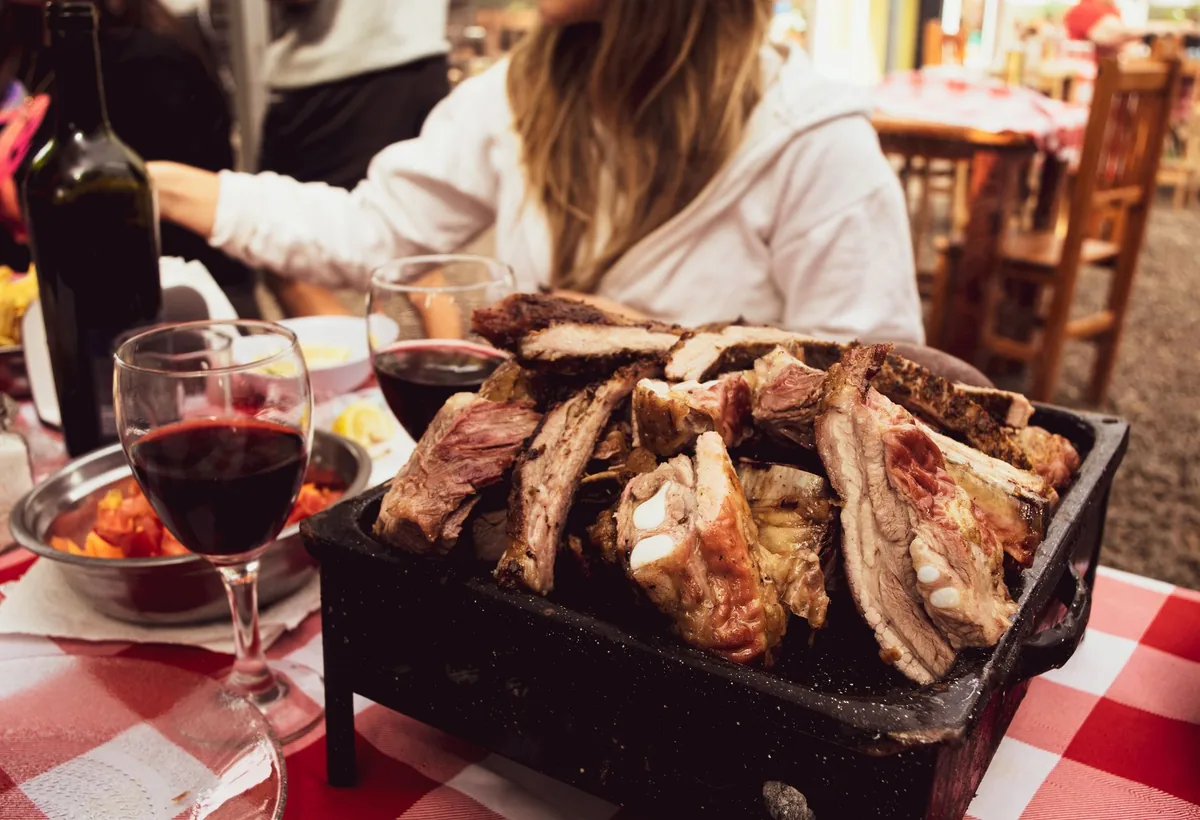
Mountain fruit gives firm acidity and fine, dry tannin rather than plushness. The wines want protein and salt, and they rarely want sugar.
- Ridge-grown Cabernet Sauvignon — roast beef, aged hard cheese, mushrooms in butter.
- Pinot Noir from the ocean side — grilled salmon, duck breast, earthy vegetables.
- Chardonnay — crab, halibut, anything with brown butter.
- Zinfandel and Rhône blends — sausage, braised pork, tomato and herb.
Santa Cruz Mountains FAQ
Which counties does the appellation cover?
Parts of Santa Cruz, Santa Clara and San Mateo counties. Because the boundary follows elevation, none of the three is included in full and the county name on a label tells you little.
How much of the appellation is actually planted?
A very small fraction, on the order of 1,500 acres out of roughly 480,000. Most of the land is forest, park, watershed or too steep to farm.
Is Santa Cruz Mountains fruit a cool-climate style?
It depends entirely on which side of the ridge it came from. Ocean-facing sites are genuinely cold, while bay-facing sites above 800 feet ripen Cabernet Sauvignon reliably most years.
Are there sub-appellations inside it?
One, Ben Lomond Mountain, approved in 1988. Everything else in the range is informal, described by ridge or canyon name rather than by any recognized boundary.

Ask one question before anything else about a bottle from this range: was the fruit above the fog or below it? Everything that follows — the acid, the tannin, the picking date, even which grape was planted there in the first place — is downstream of that single answer.